

Joint SwRI-NCAR tool integrates global solar active region observations with a physical model, machine learning

New research by Southwest Research Institute (SwRI) and the National Science Foundation’s National Center for Atmospheric Research (NSF-NCAR) has developed a new tool providing a first step toward the ability to forecast space weather weeks in advance, instead of just hours. This advance warning could allow agencies and industries to mitigate impacts to GPS, power grids, astronaut safety and more.
“Understanding where and when large, flare-producing active regions (ARs) on the Sun would emerge is a long-standing problem in heliophysics,” said SwRI’s Dr. Subhamoy Chatterjee, an early-career scientist who co-authored a new Astrophysical Journal paper about this research. “These regions display tangled magnetic fields and produce explosive solar events, potentially causing hazardous space weather such as solar flares and coronal mass ejections (CMEs).”
Solar active regions do not emerge randomly. Instead, they cluster along large-scale, warped magnetic “toroidal bands.” Using magnetic measurements from the Solar Dynamics Observatory’s Helioseismic and Magnetic Imager (February 14, 2024), the team demonstrated that surface patterns can be inverted to reconstruct critical states beneath the surface.
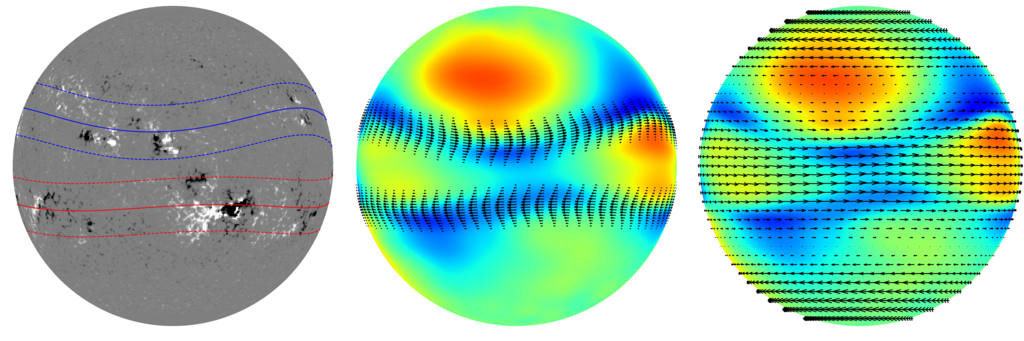
Most current forecasting tools rely on small-scale magnetic signatures that become predictive only hours before eruption. The SwRI, NSF-NCAR team developed PINNBARDS, a Physics-Informed Neural Network-Based AR Distribution Simulator, to connect surface observations of solar active regions to the deep magnetic dynamics of the Sun’s tachocline region. This thin transition layer is located between the uniformly rotating radiative interior and the more turbulent rotations of the outer convection zone.
By bridging surface observations and deep solar magnetic dynamics, SwRI and NCAR scientists are advancing a new generation of physics-informed, AI-enabled forecasting tools to better understand and anticipate extreme space weather. Using global magnetic information, the PINNBARDS framework offers the potential for substantially longer forecast lead times, which is critical for safeguarding satellites, communications infrastructure and future human space exploration.
“The reconstructed subsurface states from PINNBARDS provide initial conditions for forward simulations of solar magnetic evolution, opening the door to predicting where and when large, flare-producing active regions are likely to emerge weeks in advance,” said Dr. Mausumi Dikpati, a senior scientist from NSF-NCAR who led the team and co-authored the paper.
The latitude and longitude of emerging active regions are critical because the location determines if resulting bursts of solar particles are destined to reach our region of the solar system.