

What happens when a solar superstorm hits Mars? Thanks to the European Space Agency’s Mars orbiters, we now know: glitching spacecraft and a supercharged upper atmosphere.

In May 2024, Earth was hit by the biggest solar storm recorded in over 20 years. It sent our planet’s atmosphere into overdrive, triggering shimmering auroras that were seen as far south as Mexico.
This storm also hit Mars. Fortunately, ESA’s two Mars Orbiters – Mars Express and ExoMars Trace Gas Orbiter (TGO) – were in the right place at the right time, with a radiation monitor aboard TGO picking up a dose equivalent to 200 ‘normal’ days in just 64 hours.
A new study to be published in Nature Communications on Thursday 5 March reveals in greater depth how this intense, stormy activity affected the Red Planet.
“The impact was remarkable: Mars’s upper atmosphere was flooded by electrons,” says ESA Research Fellow Jacob Parrott, lead author of the study. “It was the biggest response to a solar storm we’ve ever seen at Mars.”
The superstorm caused a dramatic increase in electrons in two distinct layers of Mars’s atmosphere at altitudes of around 110 and 130 km, with numbers rising by 45% and a whopping 278%, respectively. This is the most electrons we’ve ever seen in this layer of martian atmosphere.
“The storm also caused computer errors for both orbiters – a typical peril of space weather, as the particles involved are so energetic and hard to predict,” adds Jacob. “Luckily, the spacecraft were designed with this in mind, and built with radiation-resistant components and specific systems for detecting and fixing these errors. They recovered fast.”
Pioneering a new technique
To investigate the superstorm’s impact on Mars, Jacob and colleagues used a technique currently being pioneered by ESA known as radio occultation.

First, Mars Express beamed a radio signal to TGO at the very moment it was disappearing over the martian horizon. As TGO vanished, the radio signal was bent (‘refracted’) by the various layers of Mars’s atmosphere before being picked up by the orbiter, allowing scientists to glean more about each layer. The researchers also used observations from NASA’s MAVEN mission to confirm the electron densities.
“This technique has actually been used for decades to explore the Solar System, but using signals beamed from a spacecraft to Earth,” says Colin Wilson, ESA project scientist for Mars Express and TGO, and co-author of the study. “It’s only in the past five years or so that we’ve started using it at Mars between two spacecraft, such as Mars Express and TGO, which usually use those radios to beam data between orbiters and rovers. It’s great to see it in action.”
ESA uses orbiter-to-orbiter radio occultation routinely at Earth, and plans to use it more regularly in future planetary missions.
Different worlds, different weather
The superstorm was experienced very differently at Earth and Mars, highlighting the differences between the two worlds.
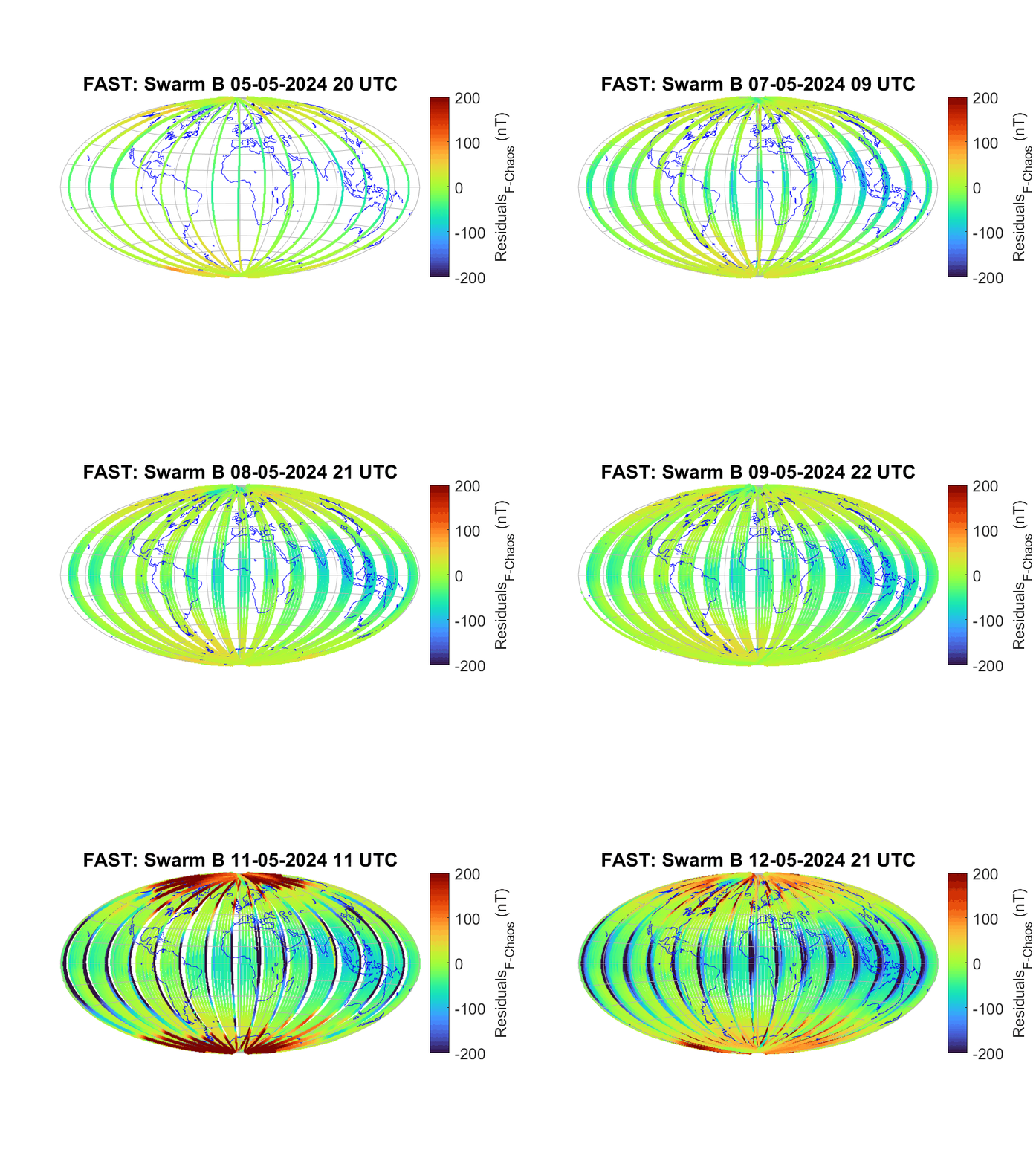
At Earth, the response of the upper atmosphere was more muted, thanks to the shielding effect of Earth’s magnetic field. As well as deflecting a lot of solar storm particles away from Earth, the magnetic field also diverted some towards Earth’s poles, where they caused the sky to light up with auroras.
While their differences can make it tricky to compare planets directly, understanding how solar activity impacts the residents of the Solar System – in other words, space weather forecasting – is hugely important. At Earth, solar storms can be dangerous and damaging for astronauts and equipment up in space, and can disrupt our satellites and systems (power, radio, navigation) further down.
However, studying space weather is difficult as the Sun throws out radiation and material erratically, making targeted measurements largely opportunistic. “Fortunately, we were able to use this new technique with Mars Express and TGO just 10 minutes after a large solar flare hit Mars. Currently we’re only performing two observations per week at Mars, so the timing was extremely lucky,” adds Jacob.
Jacob and colleagues captured the aftermath of three solar events – all part of the same storm, but different in terms of what they throw out into space, and how they do it: one flare of radiation, one burst of high-energy particles, and an eruption of material known as a coronal mass ejection (CME).
Together, these events sent fast-moving, energetic, magnetised plasma and X-rays flooding towards Mars. When this barrage of material hit the planet’s upper atmosphere it collided with neutral atoms and stripped away their electrons, causing the region to fill up with electrons and charged particles.
“The results improve our understanding of Mars by revealing how solar storms deposit energy and particles into Mars’s atmosphere – important as we know the planet has lost both huge amounts of water and most of its atmosphere to space, most likely driven by the continual wind of particles streaming out from the Sun,” says Colin.
“But there’s another side to it: the structure and contents of a planet’s atmosphere influence how radio signals travel through space. If Mars’s upper atmosphere is packed full of electrons, this could block the signals we use to explore the planet’s surface via radar, making it a key consideration in our mission planning – and impacting our ability to investigate other worlds.”
