

A study in JCAP uses observations of planets and stars to set new limits on possible electric and magnetic properties of dark matter that are difficult to test in the laboratory.
Dark matter continues to evade direct detection. Its slower-moving particles might leave signals too faint for detectors to register, yet be more easily captured by planets and stars. As they accumulate inside these bodies, they could produce effects that existing instruments would allow us to search for.
Alejandro Ibarra, Merlin Reichard and Gaurav Tomar explored this scenario by combining theoretical calculations with existing observations. Published in the Journal of Cosmology and Astroparticle Physics (JCAP), the study finds no evidence of dark matter, but rules out some combinations of its possible properties, helping researchers guide future searches.
Dark and slow?
Although it accounts for around 85% of the matter in the Universe, dark matter reveals itself mainly through its gravitational effects. It is a catch-22: if we cannot “see” it, we do not know what it is, but without some idea of what to look for, finding it becomes a daunting task. Experiments therefore test different hypotheses about its nature, so far without detecting it directly.
One possibility is that, alongside gravity, dark matter has electric or magnetic interactions so weak that they have escaped observation. Its particles might, for example, carry a tiny electric charge or behave like miniature magnets. These properties would allow them to interact with ordinary matter.
This is where speed comes into play: when colliding with the material in a detector, a slow-moving particle might transfer too little energy to leave a measurable signal. But there is a flip side: when passing through a celestial body, it would need to lose only a small amount of energy in collisions to become unable to escape its gravity.
Over billions of years, captured particles could accumulate in the central regions. Being confined to a small space would make encounters more likely and, if their nature allows it, lead to “annihilations”: processes in which they transform into other particles. These could escape or deposit energy inside the celestial body, heating it.
The Sun, Earth, Jupiter and white dwarfs
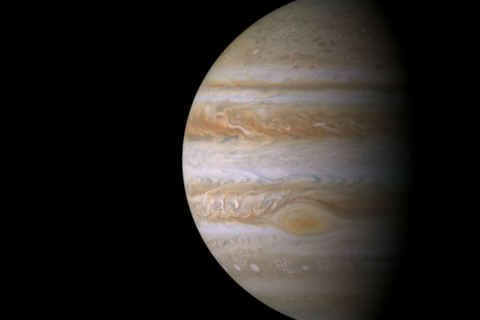
“In this work, we considered four celestial bodies: Earth, the Sun, Jupiter and white dwarfs,” explains Gaurav Tomar, a researcher at the Center for Quantum Spacetime at Sogang University in South Korea and the study’s corresponding author. “There are dedicated experiments, for example IceCube at the South Pole, looking for neutrinos from the Sun and Earth. For Jupiter and white dwarfs, we considered the heating possibilities.”
For Earth and the Sun, they used results from searches for neutrinos produced by possible dark matter annihilations. Able to travel through large amounts of matter, these neutrinos could reach detectors and provide a clue to what is happening inside the celestial body.
For Jupiter and white dwarfs, they instead considered heating. Unlike the Sun, these objects are not powered by nuclear fusion and can therefore offer more favourable conditions for identifying an additional heat source. The authors calculated how much heat dark matter would produce and compared it with the energy emitted by each body. If dark matter alone would generate more heat than the body actually emits, that particular dark matter scenario can be ruled out.
New limits
The comparison ruled out some combinations of particle mass and properties that other experiments had left open. Earth proved particularly useful for testing the possibility of a tiny electric charge, while white dwarfs can place limits on other electromagnetic properties.
However, the results depend on the assumptions used in the calculations, including how much dark matter surrounds the stars. The more dark matter there is nearby, the more particles a star could capture over time. “We do not know the dark matter density there. We used estimated values, so if those values change, our limits could become weaker or stronger,” Tomar notes, referring to the M4 cluster, which contains the white dwarfs considered in the study and where the dark matter density has not been measured and is estimated from models.
For future searches, Tomar points to even colder white dwarfs in denser dark matter regions, where any additional heating would be easier to identify, and to exoplanets: potential dark matter traps beyond our Solar System.
